
COP31 Antalya: Climate Justice & Carbon Compensation
- HABERLER
TBMag Editorial Team
- 0
- 9 minutes read

COP31 and the Climate Justice Test: How the Non-Affluent Majority Subsidised Planetary Stability
The Unsettled Ledger in Antalya
In 1928, Mahatma Gandhi issued a prescient warning in the pages of Young India: “God forbid that India should ever take to industrialism after the manner of the West. If an entire nation of 300 million took to similar economic exploitation, it would strip the world bare like locusts.”
Nearly a century on, policymakers and negotiators gathered in Antalya, Türkiye, for COP31 are confronting the precise reality Gandhi foresaw. Fossil-fuel-driven industrialisation has propelled annual global CO₂ emissions to nearly 40 billion tonnes, warming the planet by approximately 1.3–1.4°C above pre-industrial levels. According to the UN Environment Programme’s (UNEP) Limiting Overshoot assessment, breaching the critical 1.5°C threshold within the next three to four years is now virtually unavoidable.
Whilst technical pathways—expanding renewables, curbing methane, and overhauling industrial efficiency—are well established, the political deadlock in Antalya centres on a fundamental moral and economic question: Who owes compensation to the non-affluent majority bearing the brunt of a climate crisis they did not create?
“We have built a world with flawless logistics for war and broken logistics for food. We are hit by the climate we did not warm and by the wars we did not start.”
— Balendra Shah, Prime Minister of Nepal
Section 1: A New Metric — The ‘Scalability of Lifestyles’
Conventional climate diplomacy apportions responsibility through the “cumulative emissions” framework, tallying total national carbon output since 1850. Endorsed by the International Court of Justice in its 2025 advisory opinion, this metric designates major economies—the US, EU, China, Russia, Japan, and India—as primarily accountable. Yet aggregate accounting obscures the vital distinction between the “luxury emissions” of the wealthy and the “subsistence emissions” of the poor, whilst granting small, super-affluent states such as Switzerland, Luxembourg, or Singapore an implicit reprieve on the grounds of scale.
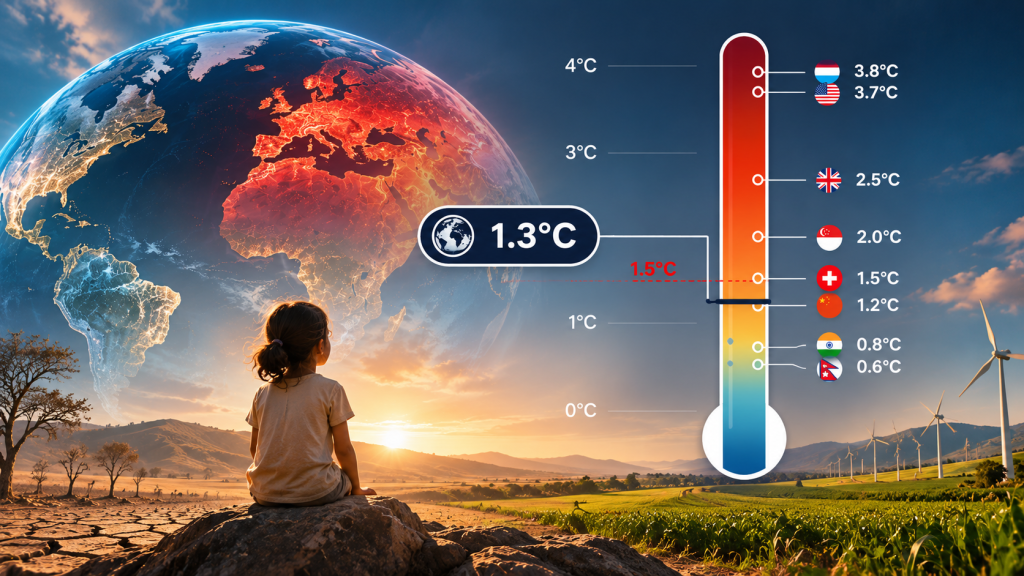
Peer-reviewed research published in the journal Climate Policy reframes Gandhi’s insight into a rigorous climate-model counterfactual: How much would the Earth have warmed had all of humanity historically lived like the average Briton, American, or Qatari?
| Scaled Historical Lifestyle (Per-Capita Basis) | Counterfactual Global Warming | 1.5°C Paris Threshold Status |
|---|---|---|
| Average Qatari | 5.0°C or higher | Catastrophic overshoot |
| Average Luxembourger | ~4.0°C | Severe overshoot |
| Average American | ~3.7°C | Severe overshoot |
| Average Briton or German | ~2.5°C | Breached threshold |
| Average Chinese (Historical) | ~1.2°C | Below current observed warming |
| Average Indian | ~0.8°C | Well within safe planetary limits |
Section 2: How the Non-Affluent Subsidised Planetary Stability
This counterfactual modelling exposes a stark geopolitical truth: had affluent Western consumption patterns been universalised globally, the 1.5°C guardrail would have been breached as early as the 1970s. Conversely, had the historical footprint of the Global South been universal, humanity would not have crossed 1.5°C until the 2070s or beyond.
In effect, the world’s non-affluent majority has inadvertently subsidised global climate stability—buying humanity a vital five-decade window for scientific discovery, renewable engineering, and policy formulation.
Section 3: From Charity to Restitution in Antalya
As heads of state depart Antalya and technical negotiators enter the decisive second week of COP31, developing nations are armed with a sharper negotiating baseline. UN Secretary-General António Guterres’s call in Antalya to honour the $300 billion annual finance pledge and triple adaptation funding by 2035 is increasingly framed not as discretionary aid, but as settled restitution.
Delivering genuine climate justice at COP31 requires five concrete structural shifts:
- Capitalising the UN Loss and Damage Fund: Delivering grant-based disbursements rather than debt-inducing loans to frontline states hit by climate disasters.
- Waiving Green Intellectual Property Barriers: Removing patent restrictions on critical mitigation and grid-storage technologies to accelerate deployment across the Global South.
- Reforming Multilateral Development Banks: Overhauling World Bank and WTO lending rules to lower the punitive cost of capital for emerging economies.
- Accelerated Net-Negative Targets: Obliging the roughly 50 affluent nations in counterfactual overshoot to bring forward net-negative industrial targets.
- Reframing the Lexicon: Establishing climate finance in international law as compensation owed for ecological stability rather than Western philanthropy.
Conclusion: Accounting for Futures Denied
As author Amitav Ghosh argued in The Great Derangement, historical injustice resides not only in overt destruction, but in the futures and developmental trajectories denied to entire nations. COP31’s legacy will ultimately be measured by whether the Antalya accord moves beyond carbon bookkeeping to settle this deeper structural debt.
THE TBMAG WEEKLY
Stay Ahead of the UK–Türkiye Business Corridor
Weekly insights on business, healthcare, investment and culture — delivered every Thursday. Available in English and Turkish.
No spam · Unsubscribe anytime
